
Artificial Intelligence (AI) has become one of the most important technologies in digital marketing. In 2026, AI is helping businesses of all sizes understand their target audience, produce engaging content, improve advertising strategies, analyze valuable data, and create personalized customer experiences.
Digital marketing is evolving rapidly as AI can analyze huge amounts of data and help marketers make quicker, more informed decisions.
. Tasks that once required hours of manual work can now be completed more efficiently with the help of AI-powered tools.
From SEO and social media marketing to Google Ads, email marketing, and content creation, AI is becoming a valuable part of modern marketing strategies.
In this blog, we will explore how AI is changing digital marketing in 2026, its major benefits, popular applications, challenges, and the future of AI in the digital marketing industry.
What Is AI in Digital Marketing?
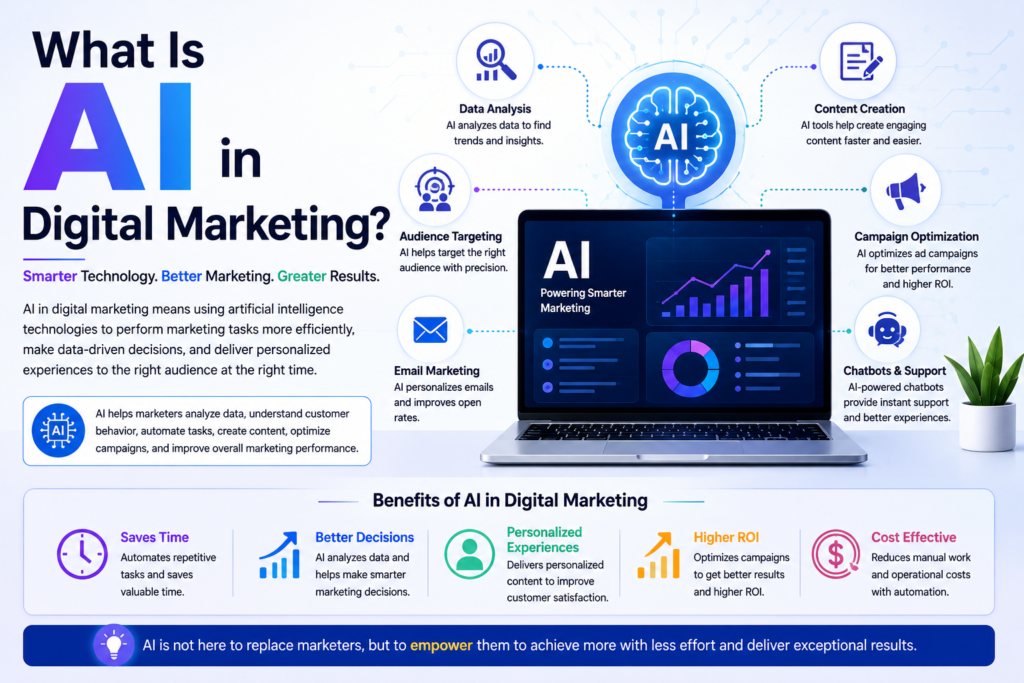
Artificial Intelligence in digital marketing means using AI technologies to perform tasks that normally require human intelligence.
AI systems can analyze data, recognize patterns, understand language, generate content, predict customer behavior, and automate repetitive tasks.
For instance, AI-powered tools can help marketers with tasks such as:
- Find content ideas
- Research keywords
- Create content drafts
- Analyze customer behavior
- Personalize marketing messages
- Automate email campaigns
- Improve advertising performance
- Generate reports
- Answer customer questions
AI does not completely replace digital marketers. Instead, it helps marketers save time and focus more on strategy, creativity, communication, and decision-making.
1. AI Is Transforming Content Creation
Content marketing is one of the key areas where AI has made a significant impact.
Marketers can use AI tools to generate ideas, outlines, social media posts, product descriptions, email drafts, and other marketing materials.
For example, a digital marketer writing a blog can use AI to brainstorm topics and create an initial outline. The marketer can then add personal experience, examples, accurate information, and brand-specific details.
AI can also help marketers customize content to suit different social media platforms and online channels.
A long blog post can be turned into social media captions, email content, or short video scripts.
However, marketers should not depend entirely on AI-generated content. Human editing, fact-checking, originality, and creativity remain important.
The best approach is to use AI as an assistant rather than simply publishing everything it generates.
2. AI Is Changing SEO
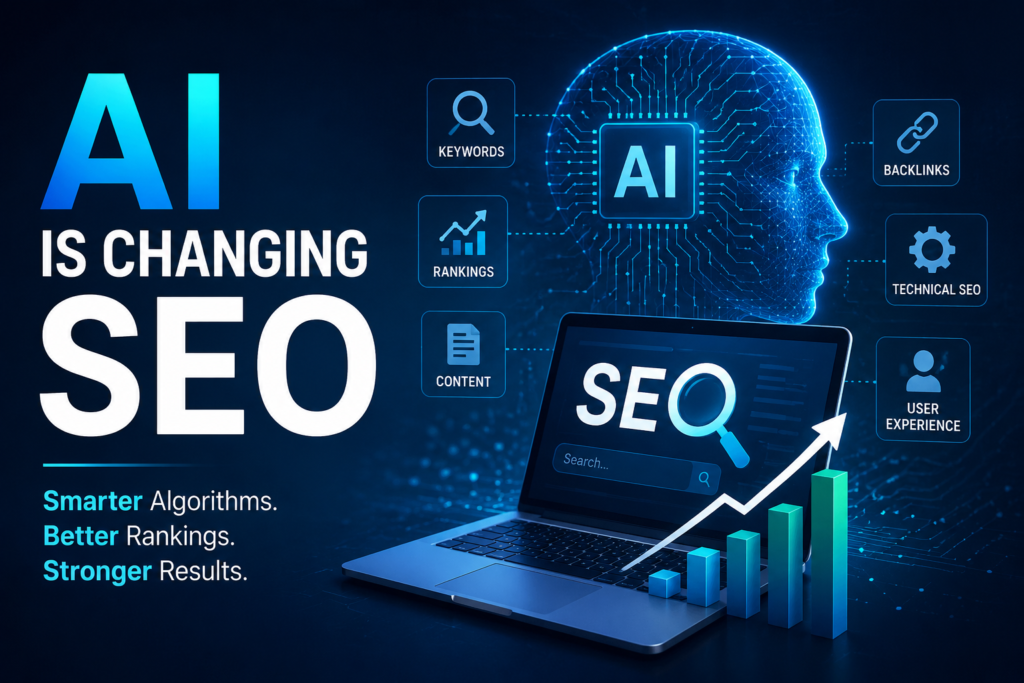
Search Engine Optimization is another area where AI is having a major impact.
AI-powered SEO tools can help marketers with keyword research, content analysis, competitor research, topic ideas, and website optimization.AI can analyze search trends and find topics that are relevant to the target audience.
It can also help marketers understand search intent and organize content around related topics.
For example, instead of focusing only on one keyword, marketers can create comprehensive content that answers multiple questions related to a topic.
AI can also detect technical SEO problems and help marketers understand how well a website is performing.
.
However, SEO still requires human judgment. Marketers need to understand the audience, create genuinely useful content, and make sure information is accurate and trustworthy.
3. Personalized Marketing Experiences
Customers expect businesses to provide relevant experiences. AI makes personalization easier by analyzing customer data and behavior.
For example, an online store can use AI to recommend products based on a customer’s previous searches or purchases.
Similarly, an email marketing platform can use customer behavior to determine which messages may be more relevant to different users.
Personalization can be used in:
- Email marketing
- Website recommendations
- Product suggestions
- Advertising
- Social media
- Customer support
Instead of sending the same message to everyone, businesses can create more targeted experiences.
4. AI-Powered Chatbots and Customer Support
AI chatbots are becoming increasingly common in digital marketing and customer service.
Traditional customer support may require employees to answer the same questions repeatedly. AI-powered chatbots can handle many common questions automatically.
For example, a chatbot can answer questions about:
- Business hours
- Product information
- Pricing
- Order status
- Services
- Appointment details
- Frequently asked questions
This can help businesses provide support outside normal working hours.
However, human support is still important when dealing with complex or sensitive issues.
. A good customer service strategy combines AI automation with human assistance.
5. AI Is Improving Social Media Marketing
Social media marketers have to create content, monitor engagement, analyze trends, and communicate with audiences regularly.
AI can help automate these tasks and make them more efficient.
AI tools can suggest social media content ideas, generate captions, analyze engagement data, identify trends, and help marketers understand what types of content perform well.
AI can also help businesses analyze audience behavior and determine suitable content formats.
For example, if short videos consistently receive more engagement than static posts, a marketer can adjust the content strategy accordingly.
However, social media still depends heavily on creativity and genuine communication. AI should support the strategy rather than replace the human personality of a brand.
6. Smarter Google Ads and PPC Campaigns
AI is also changing paid advertising.
Advertising platforms increasingly use machine learning and automation to help marketers optimize campaigns. AI can analyze signals such as audience behavior, device type, location, and previous interactions to help determine which users are more likely to respond to an advertisement.
AI can assist marketers with:
- Audience targeting
- Bid optimization
- Ad variations
- Campaign analysis
- Performance forecasting
- Budget optimization
This can save marketers time and help them make better decisions based on data.
.
However, marketers still need to set appropriate goals, monitor campaigns, review results, and make strategic decisions.
7. AI Is Making Email Marketing Smarter
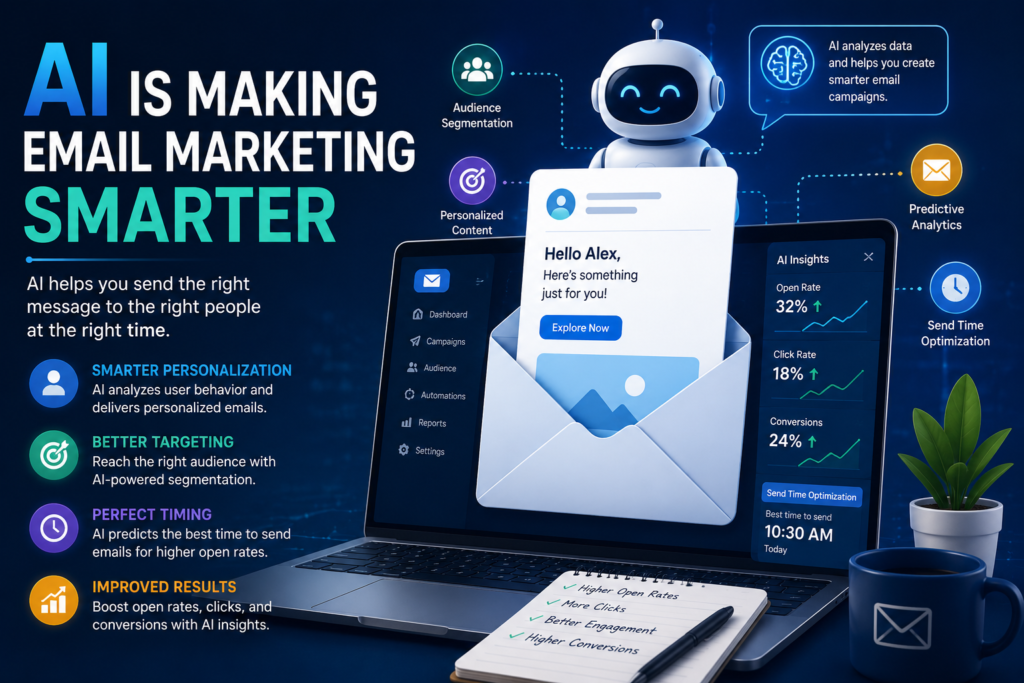
Email marketing is another area where AI can help improve results and make campaigns more effective.
AI can help marketers determine what type of content may be relevant to different audiences. It can also assist with subject lines, email copy,segmentation, and campaignanalysis.
For example, an online business can divide its audience into different groups based on interests or previous interactions.
A customer who has purchased a product may receive a follow-up recommendation, while a newvisitor may receive an introductory email.
This type of personalization can make email marketing more relevant and useful.
8. Predictive Analytics and Customer Behavior
One of the biggest advantages of AI is its ability to analyze large amounts of data.
Marketers can use AI-powered analytics to identify patterns in customer behavior and make predictions.
For example, AI may help businesses understand:
- Which products customers are interested in
- When customers are most active
- Which marketing channels perform best
- Which customers are likely to convert
- Which campaigns generate better results
Predictive analytics can help marketers make better decisions based on data rather than assumptions.
Businesses can use these insights to improve their marketing strategies and allocate resources more effectively.
9. AI Helps Marketers Save Time
Digital marketers perform many repetitive tasks every day.
AI can automate some of these tasks and give marketers more time for important activities.
For example, AI can help with:
- Report generation
- Data analysis
- Content ideas
- Social media scheduling
- Email segmentation
- Keyword research
- Customer support
- Campaign monitoring
Saving time does not mean marketers become less important. Instead, marketers can spend more time on creative thinking, strategy, brand development, and building relationships with customers.
10. AI Is Improving Video and Visual Content
Video has become an important part of digital marketing. AI is making it easier for marketers to create and edit visual content.
AI-powered tools can assist with video scripts, captions, subtitles, image creation, editing, and content repurposing.
For example, a marketer can turn a long-form article into a short video script and create multiple pieces of content from one idea.
This allows small businesses and individual creators to produce more content without needing a large production team.
Human creativity and brand identity remain important because AI-generated visuals should still match the company’s style and message.
Benefits of AI in Digital Marketing
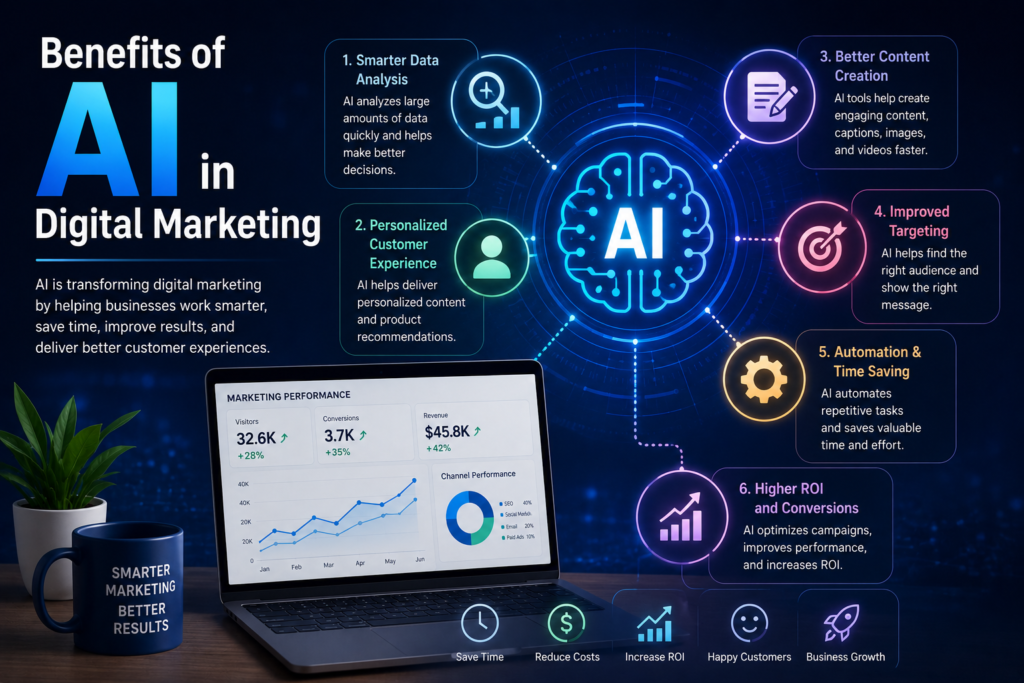
AI provides several benefits to modern marketers.
Faster Work
AI can complete many repetitive tasks quickly, helping marketers save valuable time.
Better Data Analysis
AI can process large amounts of information and identify patterns that may be difficult to find manually.
Personalization
Businesses can create more relevant experiences based on customer interests and behavior.
Improved Efficiency
Automation can reduce repetitive manual work and allow marketing teams to focus on higher-value tasks.
Better Decision-Making
AI-powered insights can help marketers make data-driven decisions.
Cost Savings
Automation can reduce the amount of time required for certain marketing activities, which can be especially useful for small businesses.
Challenges of Using AI in Digital Marketing
Although AI offers many advantages, it also has challenges.
Lack of Human Creativity
AI can generate content, but human creativity, emotions, experiences, and storytelling are still valuable.
Accuracy Problems
AI-generated information can sometimes be incorrect. Marketers should verify important facts before publishing content.
Privacy Concerns
Businesses must handle customer data responsibly and follow applicable privacy requirements.
Overdependence on AI
Using AI for every task can make marketing content repetitive and less authentic.
Need for Human Oversight
AI-generated content, advertisements, and recommendations should be reviewed by humans before being used publicly.
The best strategy is to combine AI technology with human knowledge and creativity.
How Digital Marketers Can Use AI Effectively
Digital marketers should focus on using AI as a productivity and decision-support tool.
A good AI workflow can include:
- Identify the marketing goal.
- Use AI to research and generate ideas.
- Review the AI output carefully.
- Add human creativity and expertise.
- Fact-check important information.
- Optimize the content for the target audience.
- Publish and monitor performance.
- Use the results to improve future campaigns.
This approach allows marketers to benefit from AI while maintaining quality and authenticity.
The Future of AI in Digital Marketing
AI will continue to influence digital marketing as technology develops.
Future marketing strategies are likely to become more personalized, automated, and data-driven. Businesses will increasingly use AI to understand customers and improve marketing experiences.
However, technology alone will not guarantee marketing success.
Successful marketers will still need communication skills, creativity, strategic thinking, analytical skills, and a strong understanding of their audience.
The future is not simply about AI replacing marketers. It is more about marketers using AI effectively to work smarter and create better experiences for customers.
Conclusion
AI is changing digital marketing in 2026 by making content creation, SEO, social media marketing, advertising, email marketing, analytics, and customer support more efficient.
Businesses can use AI to save time, analyze data, personalize customer experiences, and improve marketing campaigns.
At the same time, human creativity, accuracy, strategy, and ethical decision-making remain essential. AI-generated content should be reviewed and improved rather than published without checking.
The most successful digital marketers will be those who understand how to combine AI technology with human creativity and marketing expertise.
As AI continues to develop, businesses that learn to use it responsibly and strategically can gain new opportunities to connect with their audiences, improve performance, and grow their online presence.