
If you have a website, getting visitors is one of the most important parts of growing your online presence. A website can have great products, services, or content, but without visitors, it may be difficult to reach potential customers.
Learning how to increase website traffic can help businesses attract more visitors, generate leads, build brand awareness, and increase sales. The good news is that you do not always need a large advertising budget to bring people . With the right digital marketing strategies, you can gradually increase traffic and build a stronger online presence.
In this guide, we will explore practical ways to including SEO, content marketing, social media, email marketing, paid advertising, and other useful strategies.
What Is Website Traffic
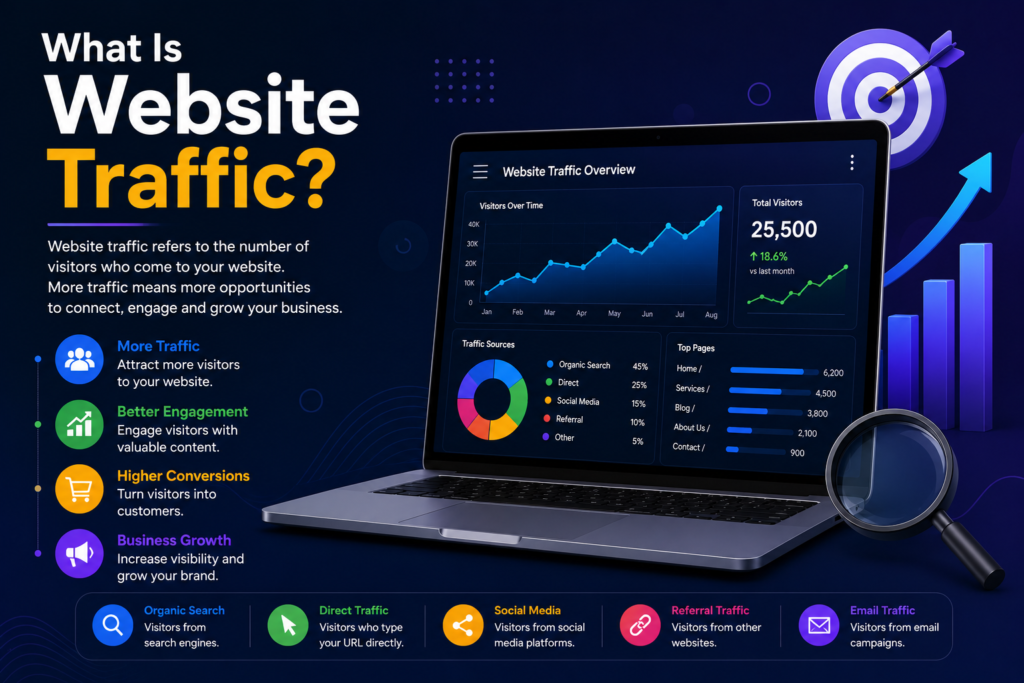
traffic refers to the number of visitors who access a website. It shows how many people are visiting your website and can help you understand how well your online presence is performing.
Website traffic can come from different sources, including:
- Search engines
- Social media
- Direct visits
- Email marketing
- Online advertisements
- Referral
For example, when someone searches for a service on Google and visits your website through the search results, that visit is considered organic search traffic.
Understanding where your visitors come from can help you choose better marketing strategies.
Why Is Website Traffic Important?
important because visitors can become customers, subscribers, or leads.
A consistent flow of visitors can help you:
- Increase brand awareness
- Generate leads
- Increase sales
- Promote products and services
- Build an online audience
- Improve brand visibility
- Grow your business
However, getting more visitors is not the only goal. You should also focus on reaching the right audience who are genuinely interested in your products or services. A smaller number of relevant visitors can be more valuable than thousands of visitors who have no interest in your products or services.
1. Improve Your Website SEO
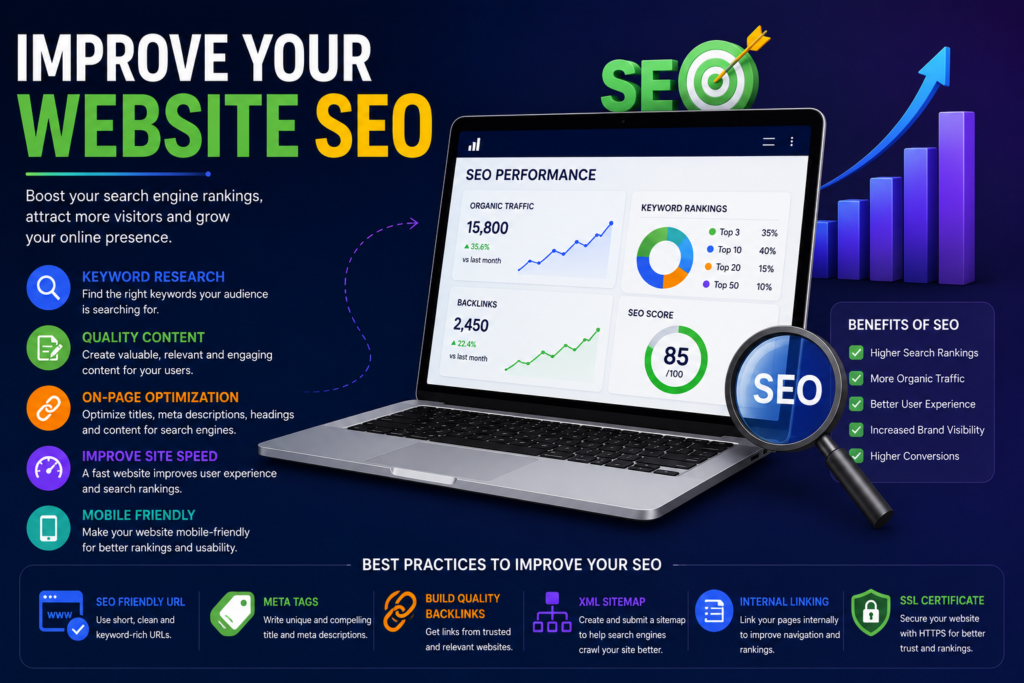
One of the most effective ways to Search Engine Optimization (SEO).
SEO helps your webpages appear in search engine results when people search for relevant topics, products, or services.
Begin by researching relevant keywords that your target audience commonly searches for online. For example, if you provide digital marketing services, you could target keywords such as:
- Digital marketing services
- SEO services
- Social media marketing
- Google Ads services
- Digital marketing consultant
Use your target keywords naturally in your:
- Page title
- Headings
- Introduction
- Website content
- Meta description
- Image alt text
- URL
Avoid keyword stuffing. Your content should be written primarily for people and should provide useful information.
2. Create High-Quality Content
Content marketing is another effective way to increase traffic.
People use search engines to find answers to questions and solutions to problems. By creating useful content, you can attract people who are searching for information related to your business.
You can create:
- Blog posts
- Guides
- Tutorials
- Videos
- Infographics
- Case studies
- FAQs
- Checklists
For example, a digital marketing could publish articles such as:
- How to improve SEO
- Social media marketing tips
- Google Ads tips for beginners
- How to create a content strategy
- Best digital marketing tools
Try to create content that answers real questions and provides practical solutions.
3. Use Long-Tail Keywords
Long-tail keywords are specific search phrases that usually contain several words.
For example:
Short keyword: SEO
Long-tail keyword: SEO tips for small businesses
Long-tail keywords can help you reach users with specific search needs and intentions.They may also be easier to target than very broad keywords.
Before writing a blog post, think about what your audience is searching for and choose keywords that closely match the topic.
Use long-tail keywords naturally throughout your content without repeating them unnecessarily.
4.Mobile-Friendly
Many people use smartphones to access websites and browse the internet.
Therefore, having a mobile-friendly
A mobile-friendly should:
- Display properly on different screen sizes
- Have readable text
- Load quickly
- Use simple navigation
- Have easy-to-click buttons
- Avoid unnecessary pop-ups
If visitors have difficulty using your website on a smartphone, they may leave quickly.
Improving the mobile experience can make it easier for visitors to explore your interact with your content.
5. Improve Website Loading Speed
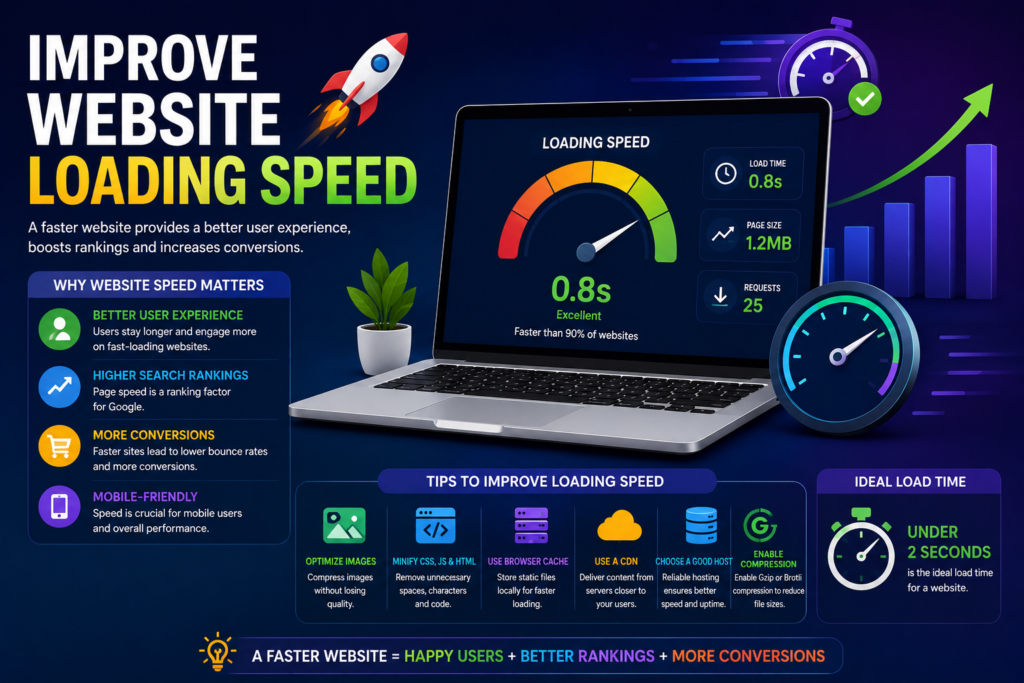
speed can affect the user experience. Visitors usually do not want to wait for a slow webpage to load.
You can improve website speed by:
- Compressing images
- Removing unnecessary plugins
- Using optimized website themes
- Reducing large files
- Using browser caching
- Choosing reliable hosting
A faster website can provide a better experience for visitors and make it easier for them to browse multiple pages.
6. Promote Your Content on Social Media
Social media can help you reach a larger audience and bring visitors to your website.
You can share your blog posts, products, services, and other useful content on platforms such as:
- YouTube
- TikTok
For example, if you publish a blog about SEO, you can create a short Instagram Reel explaining one SEO tip and direct interested users to the full article on your website.
Do not simply post links repeatedly. Create valuable and engaging content that encourages users to visit your website.
7. Use Email Marketing
Email marketing can be an effective way to bring existing audiences
Build an email list through legitimate methods and send useful content to your subscribers.
You can share:
- New blog posts
- Special offers
- Product updates
- Company news
- Helpful tips
- Educational content
For example, after publishing a new blog post, you can send your subscribers a short email introducingthe topic and include a link to read the complete article.
Avoid sending too many emails. Focus on sharing useful and valuable content with your subscribers.
8. Build Quality Backlinks
Backlinks arelinks from other to your website.
When reputable and relevant websites link to your content, they can help increase your visibility and authority.
Some ways to earn backlinks include:
- Creating useful original content
- Publishing research or statistics
- Writing guest posts
- Getting listed in relevant directories
- Building relationships with industry websites
- Creating helpful resources
Focus on quality and relevance rather than trying to get a large number of backlinks.
Avoid buying low-quality backlinks because they may harm your website’s reputation.
9. Use Google Business Profile for Local Traffic
If you operate a local business, a Google Business Profile can help people discover your business online.
For example, restaurants, salons, dental clinics, gyms, and local shops can use local search optimization to reach nearby customers.
Keep your business information accurate and updated.
Important information includes:
- Business name
- Address
- Phone number
- Website
- Opening hours
- Business category
- Photos
- Customer reviews
Positive and genuine customer reviews can also help build trust with potential customers.
10. Try Paid Advertising
Organic traffic can take time to build. Paid advertising can help businesses reach potential customers more quickly.
Platforms such as Google Ads and social media advertising allow businesses to target specific audiences.
You can use paid advertising to promote:
- Products
- Services
- Blog posts
- Landing pages
- Special offers
- Events
Start with a small budget and monitor your results.
Important metrics include:
- Clicks
- Click-through rate
- Cost per click
- Leads
- Conversions
- Cost per conversion
Do not focus only on getting clicks. The goal should be to attract visitors who are likely to take meaningful actions.
11. Use Internal Linking
Internal links connect one page on your website to another page on the same website.
For example, if you have a blog about website traffic and another article about SEO, you can link the SEO article from your website traffic article.
Internal linking can help:
- Visitors discover related content
- Search engines understand your website structure
- Users spend more time exploring your website
- Important pages receive more visibility
Use descriptive anchor text that clearly explains what the linked page is about.
12. Update Old Content
Creating new content is useful, but updating existing content can also help improve website performance.
Review your older blog posts regularly and update:
- Outdated information
- Statistics
- Links
- Examples
- Keywords
- Images
- Headings
You can also add new sections when necessary.
Keeping content fresh can make your articles more useful to readers and help maintain their relevance.
13. Track Your Website Traffic
You cannot improve what you do not measure.
Use analytics tools to understand how people find and use your website.
Important metrics include:
- Total visitors
- Organic traffic
- Page views
- Engagement
- Traffic sources
- Conversion rate
- Top-performing pages
For example, if most of your visitors come from Google, you may want to invest more time in SEO and content creation.
If social media sends many visitors, you can experiment with different social media content formats.
Common Mistakes to Avoid
When trying to increase website traffic, beginners often make several mistakes.
Focusing Only on Quantity
Getting thousands of visitors is not useful if they are not interested in your business. Focus on attracting relevant visitors.
Keyword Stuffing
Repeating keywords excessively can make content difficult to read. Use keywords naturally.
Ignoring Mobile Users
A website that works poorly on smartphones can lose potential visitors.
Buying Fake Traffic
Fake visitors do not provide meaningful engagement, leads, or sales.
Expecting Immediate Results
SEO and content marketing often take time. Consistency is important.
A Simple Website Traffic Strategy for Beginners
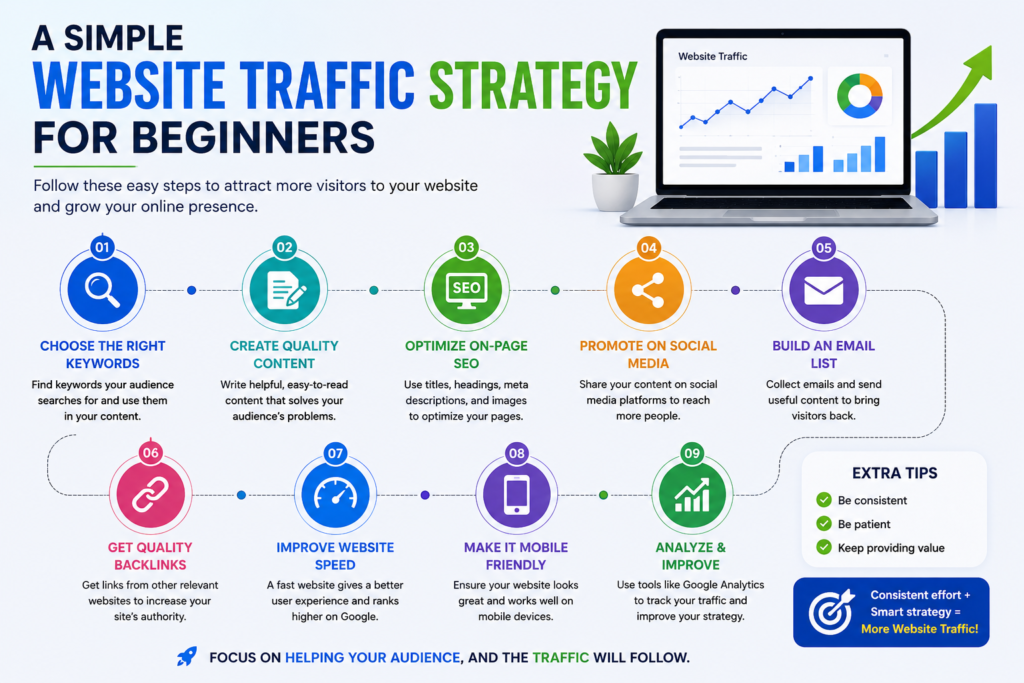
If you are just starting, follow these simple steps:
Step 1: Identify your target audience.
Step 2: Research relevant keywords.
Step 3: Create a mobile-friendly website.
Step 4: Publish useful and original content.
Step 5: Optimize your pages for SEO.
Step 6: Promote your content on social media.
Step 7: Build an email audience.
Step 8: Earn quality backlinks.
Step 9: Test paid advertising if appropriate.
Step 10: Track your results and improve your strategy.
You do not need to implement every strategy at once. Start with SEO and useful content, then gradually add other channels.
If you want any digital marketing service for your business Contact me
Conclusion
Learning how to increase website traffic takes time, but it becomes easier when you follow a clear strategy. SEO, content marketing, social media, email marketing, backlinks, paid advertising, and internal linking can all help attract more visitors to your website.
The most important thing is to focus on the right audience rather than simply trying to increase visitor numbers. Create useful content, optimize your website, provide a good user experience, and regularly measure your results.
Remember that website growth does not happen overnight. Stay consistent, keep learning, test different strategies, and use your data to improve your approach.
With the right combination of SEO and digital marketing strategies, you can gradually increase traffic, reach more potential customers, and build a stronger online presence.